When collectors and dealers examine a vintage Italian light fixture, they look at the glass first — but the metal often tells the more precise story. The alloys used, the finishing techniques, the construction methods, and even the patina of age are all period-specific. Once you know what to look for, the metalwork alone can place a piece within a decade.
This guide covers the main metal types used in Italian lighting from the 1940s through the 1980s, what each looks like, and what it tells you about when a piece was made.
Why Metal Matters for Dating
Glass techniques on Murano changed slowly and were often revived across decades — a sommerso technique used in 1955 looks very similar to one used in 1972. Metal, by contrast, followed industrial and design trends much more precisely. The availability of materials, the cost of finishing processes, and the aesthetic preferences of each decade all left clear marks on the metalwork of Italian lighting.
Metal also ages in predictable ways. Genuine patina — the oxidation, micro-scratching, and colour shift that comes from decades of use — is very difficult to fake convincingly. A piece with authentic aged metal is almost certainly the age it appears to be.
The Main Metals and What They Tell You
Polished Chrome — 1950s to mid-1970s
Chrome plating was the dominant finish for Italian lighting hardware from the postwar period through the early 1970s. It was applied over brass or steel and produced a bright, mirror-like surface that complemented the reflective quality of Murano glass.
What genuine period chrome looks like: Bright but not perfectly uniform. Under close inspection, you will see micro-scratches from decades of cleaning, slight dulling at contact points (where the glass rests against the metal), and in some cases a faint yellowish or bluish tint where the chrome has thinned. The plating on genuine 1960s–70s pieces is typically thicker and more even than on later reproductions.
What to watch for: Very bright, perfectly uniform chrome with no signs of age is a warning sign on a piece claimed to be from the 1960s or 70s. Either the piece has been re-chromed (which reduces value) or it is a later reproduction. Re-chromed pieces often show slight colour differences between the base metal and the plated areas, and the chrome may appear slightly blue-white rather than the warmer silver of original period plating.
Makers associated with chrome: Mazzega, La Murrina, De Majo, Veca, and most major Murano lighting producers of the 1960s–70s used chrome as their primary hardware finish.
Brushed or Satin Chrome — late 1960s to 1980s
From the late 1960s onward, brushed or satin-finished chrome became increasingly common, particularly in pieces with a more architectural or Brutalist aesthetic. The finish was achieved by abrading the chrome surface after plating to produce a matte, directional texture.
What it looks like: A fine, consistent linear texture across the metal surface, visible under raking light. The texture runs in one direction and is uniform — this is a machine process, not hand-finishing. Genuine period brushed chrome has a warm grey tone; later reproductions often appear cooler and more blue-grey.
Dating significance: Brushed chrome on a Murano piece almost always indicates late 1960s or later. If a piece is claimed to be from the early 1960s or 1950s and has brushed chrome hardware, treat this with scepticism.
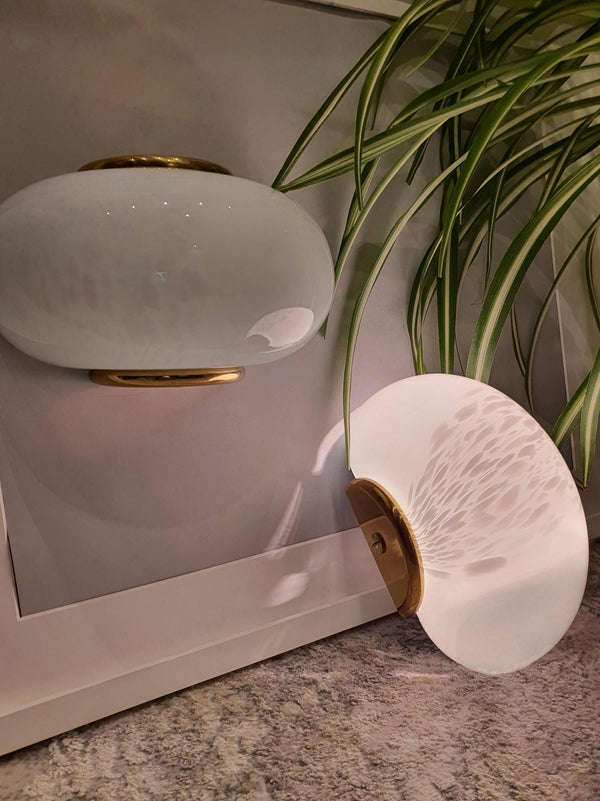
Polished Brass — 1950s, and again from the late 1970s
Brass hardware appears in two distinct periods of Italian lighting. In the 1950s, polished brass was used in more traditional or Hollywood Regency-influenced designs — chandeliers with candle arms, ornate frames, and classical proportions. It then largely gave way to chrome through the 1960s and early 70s, before returning in the late 1970s and 1980s as part of a broader revival of warm-toned, more decorative interiors.
What genuine aged brass looks like: Authentic 1950s or early 1980s brass has a warm, slightly uneven patina — darker in recesses, brighter on raised surfaces. The colour shifts from golden-yellow toward amber or even greenish-brown in areas of heavy oxidation. This patina develops over decades and is very difficult to replicate artificially without it looking either too uniform or too green.
What to watch for: Lacquered brass — where a clear coat has been applied to prevent tarnishing — was common in the 1980s. If the brass looks perfectly uniform and bright with no patina at all, it has likely been lacquered, which is a later practice. Unlacquered brass from the 1950s will show genuine age; lacquered brass from the 1980s will look almost new even decades later.
Makers associated with brass: Hollywood Regency chandeliers (often with Murano teardrop or globe elements), Barovier & Toso pieces from the 1950s, and many Venetian-style table lamps from the same period used polished brass frames.
Nickel Plating — 1950s to early 1960s
Nickel plating preceded chrome as the dominant bright metal finish in Italian lighting and was common through the 1950s and into the early 1960s. It is warmer and slightly yellower than chrome, and ages differently — developing a soft, slightly matte surface rather than the micro-scratched brightness of aged chrome.
How to distinguish nickel from chrome: Hold the piece under warm light. Nickel has a distinctly warmer, more golden tone than chrome, which reads as cool silver. Nickel also tends to develop a soft, even patina rather than the directional scratching of chrome. Under magnification, nickel plating often shows a slightly granular surface texture.
Dating significance: Nickel hardware is a strong indicator of a 1950s or very early 1960s piece. If you find nickel on a piece with glass characteristics consistent with the 1950s — heavier glass, more traditional forms, early sommerso or lattimo techniques — the metal confirms the dating.
Painted or Enamelled Steel — 1960s to 1980s
From the mid-1960s onward, painted or powder-coated steel became common in Italian lighting, particularly in pieces influenced by the Space Age aesthetic and later by Memphis and postmodern design. White, black, and primary colours were all used.
What genuine period painted steel looks like: The paint on 1960s–70s pieces was typically applied by spray or dip, and shows characteristic aging: slight yellowing of white paint (particularly around heat sources), micro-chipping at edges and contact points, and a slightly uneven surface texture under close inspection. The paint is often thinner than modern powder coating.
What to watch for: Modern powder coating is thicker, more uniform, and more durable than period paint. If a piece has a perfectly smooth, chip-free painted surface with no signs of age, it has either been repainted or is a later piece. Repainting is common and not necessarily a problem, but it should be disclosed and reflected in the price.
Makers associated with painted steel: Stilnovo, Arteluce, and many Space Age Italian lighting producers used painted steel extensively. Some Murano glass pieces — particularly flush mounts and ceiling fixtures — used white painted steel canopies and frames.
Aluminium — 1960s to 1970s
Aluminium was used in Italian lighting primarily during the 1960s and 70s, particularly in more industrial or architectural designs. It is lighter than steel, does not rust, and was often left in a natural anodised or brushed finish.
How to identify aluminium: Significantly lighter than steel or brass of the same size. Does not attract a magnet. Has a slightly grey, matte surface in its natural state. Anodised aluminium has a thin oxide layer that gives it a slightly harder, more uniform appearance than raw metal.
Dating significance: Aluminium hardware is almost exclusively a 1960s–70s indicator in Italian lighting. It is rarely found in 1950s pieces (where brass and nickel dominated) and became less common in the 1980s as brass and chrome returned to favour.
Construction Details That Confirm Dating
Beyond the metal type itself, the construction methods used to assemble the hardware are period-specific and worth examining closely.
Screws and fixings
Pre-1970s Italian lighting almost universally used slotted (flat-head) screws. Phillips-head screws became more common from the 1970s onward. Pozidriv screws (a cross-head with additional diagonal marks) are a later development still. If a piece claimed to be from the 1950s has Phillips-head screws throughout, either the screws have been replaced or the piece is not as old as claimed.
Wiring and conduit
Original 1950s–60s wiring is typically cloth-braided — a twisted fabric covering over the wire, often in brown, black, or cream. Rubber-insulated wire without fabric covering became more common from the late 1960s. Modern PVC-insulated wire is a clear indicator of rewiring or later manufacture. The presence of original cloth-braided wiring is a positive authenticity signal, though it should always be checked by an electrician before use.
Solder joints
Hand-soldered joints — slightly irregular, with visible flux residue — are characteristic of pre-1980s Italian lighting. Machine-soldered or crimped connections indicate later manufacture or repair.
Canopy and ceiling rose construction
1950s–60s canopies are typically spun or pressed from a single piece of metal, with visible tool marks on the interior. Later canopies are often cast or stamped with more uniform surfaces. The thickness of the metal also decreased over time as manufacturing became more cost-conscious through the 1970s and 80s.
Patina: The Most Reliable Indicator
Genuine patina — the accumulated evidence of age — is the hardest thing to fake and the most reliable dating tool. It develops differently on each metal type, but shares common characteristics:
- It is uneven. Real patina is heavier in recesses, at contact points, and in areas that were harder to clean. Artificially aged metal tends to be too uniform.
- It is consistent with use. Wear appears where hands touched the metal, where the fixture was adjusted, where the glass rested. Random or illogical wear patterns suggest artificial aging.
- It cannot be fully removed. Genuine patina penetrates the surface of the metal. Polishing removes the surface layer but leaves traces in micro-scratches and grain. A piece that has been aggressively polished will look bright but slightly flat — the micro-texture of genuine aged metal will be gone.
A Quick Reference by Decade
1940s–early 1950s: Nickel plating, polished brass, hand-soldered joints, cloth-braided wiring, slotted screws, spun metal canopies.
Mid-1950s–early 1960s: Transition from nickel to chrome, polished brass in traditional designs, thicker chrome plating, cloth-braided wiring, slotted screws.
Mid-1960s–early 1970s: Polished and brushed chrome dominant, painted steel in Space Age designs, aluminium in architectural pieces, early rubber-insulated wiring alongside cloth, Phillips screws beginning to appear.
Mid-1970s–1980s: Brushed chrome, painted steel, return of brass (often lacquered), thinner metal sections, Phillips and Pozidriv screws, rubber and early PVC wiring.
1980s reproductions and later pieces: Powder-coated finishes, very uniform chrome, modern PVC wiring, machine-crimped connections, lighter overall construction.
Putting It Together
No single detail is conclusive on its own. A piece with chrome hardware, cloth-braided wiring, slotted screws, and genuine uneven patina is almost certainly from the 1960s or early 70s. A piece with brushed chrome, Phillips screws, rubber wiring, and perfectly uniform patina warrants more scrutiny — it may be later than claimed, or it may have been partially restored.
The most reliable approach is to read all the evidence together: the glass technique, the metal type and finish, the construction details, the wiring, and the patina. When they all point to the same decade, you can be confident in the dating. When they conflict, ask questions.
At Vintage Glass Gems, we examine every piece in person before listing it and describe the metal, construction, and wiring condition in each product description. If you have questions about a specific piece, contact us — we are happy to share what we know.
Related Reading
→ How to Identify Authentic Murano Glass – The Collector's Guide
→ What Do the Stickers and Labels on Murano Glass Mean?
→ Mazzega Murano Glass: History and Identification
→ Where to Buy Authentic Vintage Murano Glass Lighting